The Short Version
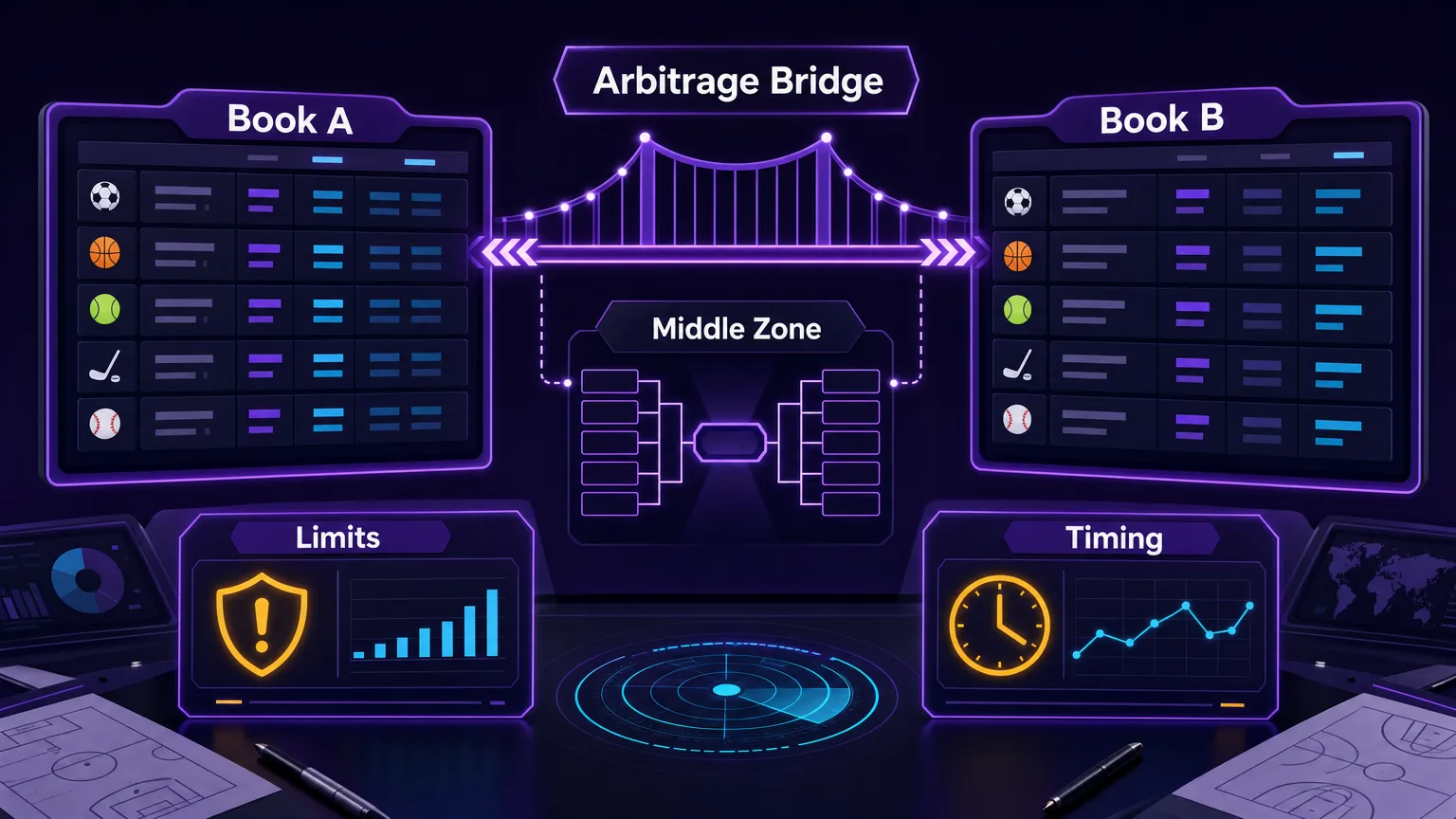
Arbitrage betting tools are designed to find differences between sportsbook prices. In theory, if two books price opposite sides of a market far enough apart, a bettor may be able to stake both sides and create a positive outcome regardless of the result. In practice, the hard part is not understanding the idea. The hard part is executing fast enough, accurately enough, and with the right book access.
That is why this article is a category guide rather than a product review. The product review for Arbitrage Pro V2 explains the Monster Bet offer itself. This guide explains how to think about arbitrage tools as a class: what they can do, what they cannot do, and how to judge whether a scanner is useful for your actual accounts.
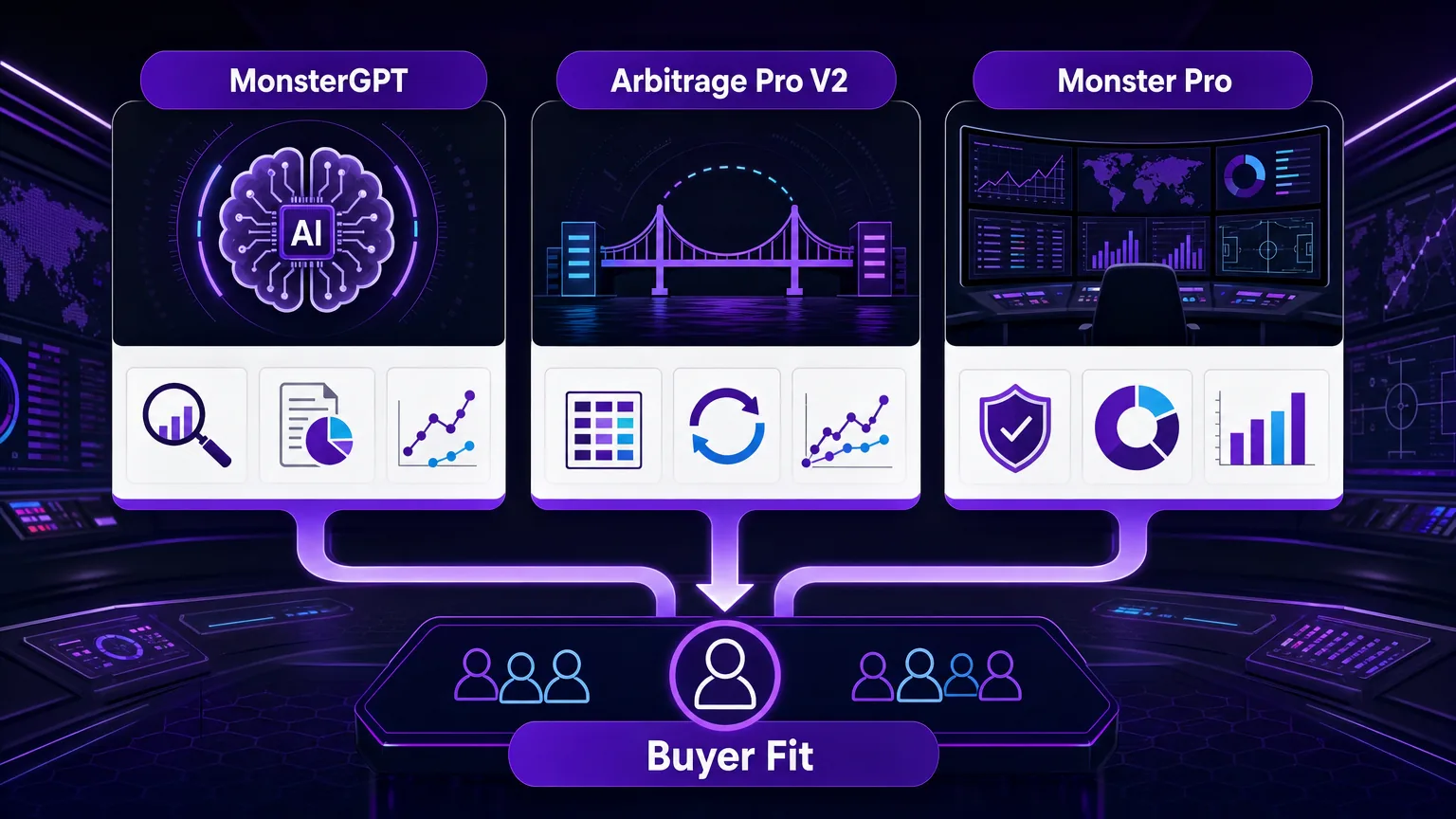
Based on the extracted Whop product research, Monster Bet’s Arbitrage Pro V2 listing included an Arbitrage Scanner, Middles Finder, multi-book monitoring across 20+ sportsbooks, MonsterGPT, and Full Lab Access. That makes it the most relevant Monster Bet CTA for this article: open Arbitrage Pro V2 on Whop.
Monster Pro also includes arbitrage and middles, but it is the broader $90/week stack. Use Monster Pro when arbitrage is only one part of a larger process. Use Arbitrage Pro V2 when arbitrage and middles are the main job.
What Arbitrage Betting Tools Do
An arbitrage tool monitors sportsbook prices and tries to detect differences large enough to create a theoretical edge. The tool usually watches markets, compares odds across books, calculates the implied probabilities, and flags opportunities where the combined implied probability may fall below 100 percent.
A simple example helps. If one sportsbook offers Team A at a generous price and another sportsbook offers Team B at a generous price, a bettor may be able to split stakes so either result returns more than the total stake. That is the clean version.
The real version requires many more checks:
| Check | Why it matters |
|---|---|
| Are both books available to you? | A scanner cannot help if the opportunity is at books you cannot access. |
| Are both prices still live? | Lines can move before both bets are placed. |
| Are market rules identical? | Overtime, void rules, and player participation rules can change the outcome. |
| Are limits high enough? | A book may not accept the required stake. |
| Is the margin large enough? | Small edges can disappear after odds movement or rounding. |
| Can you place both sides accurately? | Stake sizing mistakes can remove the theoretical edge. |
A good arbitrage tool reduces search time. It does not remove judgment.
The One Lie Behind Arbitrage Scanners
The lie: "The scanner found an arb, so the profit is already locked."
No. The scanner found a candidate.
A candidate becomes a real arbitrage only after both sides are verified, correctly sized, submitted, and accepted under matching rules. Until then, it is a possible opportunity. That distinction keeps users from treating an alert like money already earned.
The fix: separate discovery from execution.
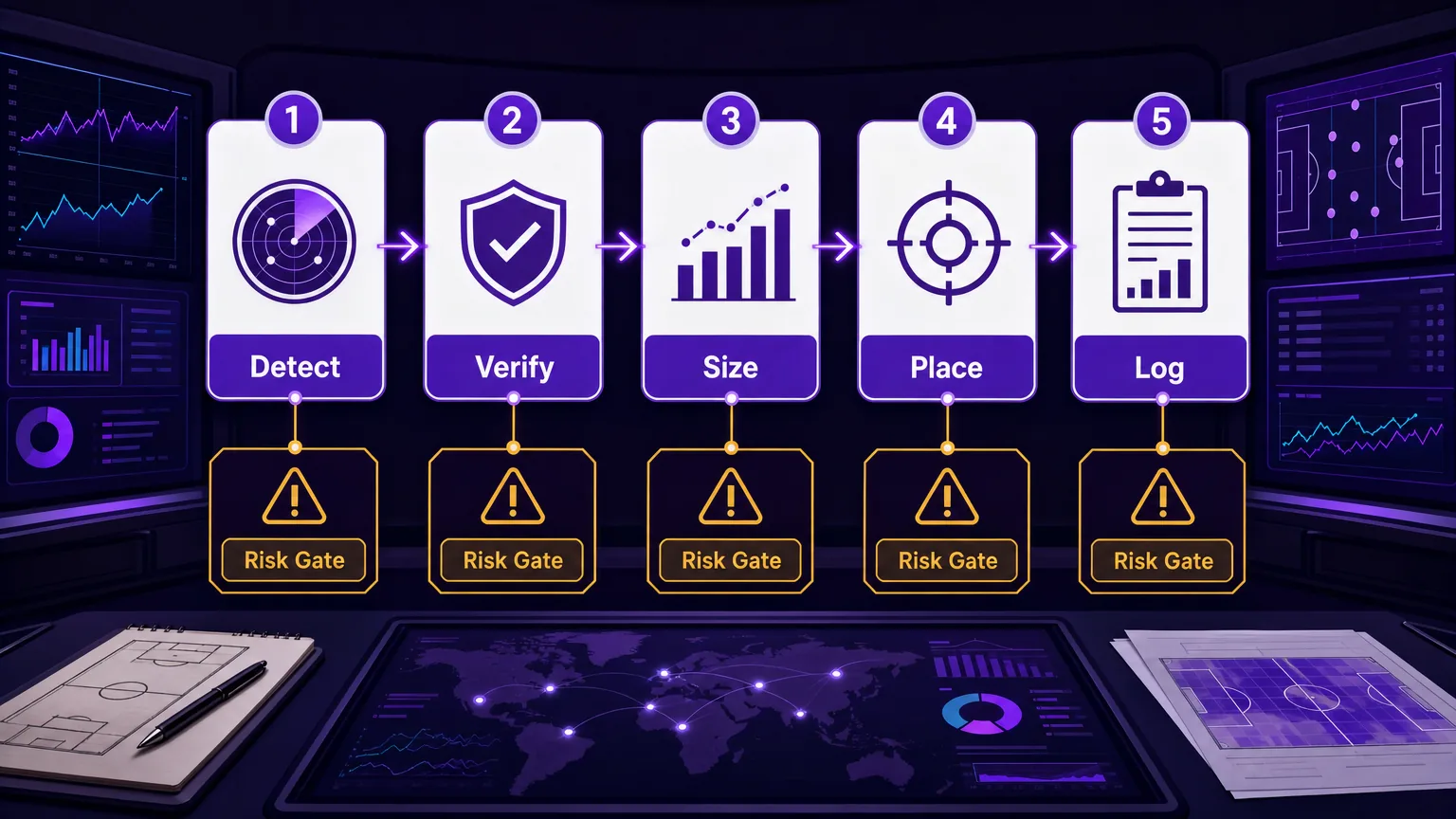
Discovery is what the scanner does. Execution is what the bettor does. A strong workflow has a checklist between those two stages. If the checklist fails, the user passes.
The number: two accepted sides.
An arbitrage position is not complete when one bet is placed. It is complete only when both required sides are accepted at the intended lines and stakes. If only one side is accepted, the bettor may be exposed to normal betting risk or worse.
The Five Parts Of A Useful Arbitrage Stack
1. Multi-Book Monitoring
Arbitrage depends on comparing books. The more relevant books a tool can monitor, the more chances it has to find discrepancies. But "more books" is not automatically better for every user. The relevant number is how many of those books you can actually use.
Before paying for any arbitrage tool, make a list of your funded sportsbook accounts. Then ask whether the scanner’s opportunities tend to appear at those books. If not, the scanner may be interesting but not executable.
2. Fast Refresh And Clear Timing
Arbitrage opportunities decay. A tool that finds an opportunity five minutes late may create more frustration than value. Useful tools make freshness visible. They help the user understand whether an alert is new, stale, live, or likely gone.
Timing also affects user behavior. If the tool encourages panic, mistakes become more likely. The interface should help users move quickly without hiding the required checks.
3. Accurate Market Matching
Market matching is underrated. Two lines can look similar while carrying different rules. A player prop may void differently across books. A spread may include overtime at one book and not another. A live market may have timing differences.
A scanner is only useful if it maps markets carefully, but users should still verify. This is especially true in lower-liquidity or fast-moving markets.
4. Stake Sizing Support
The math of arbitrage depends on stake sizing. If the user enters the wrong amounts, the theoretical result changes. A useful workflow should show required stakes clearly, ideally with enough explanation that the bettor understands what they are doing.
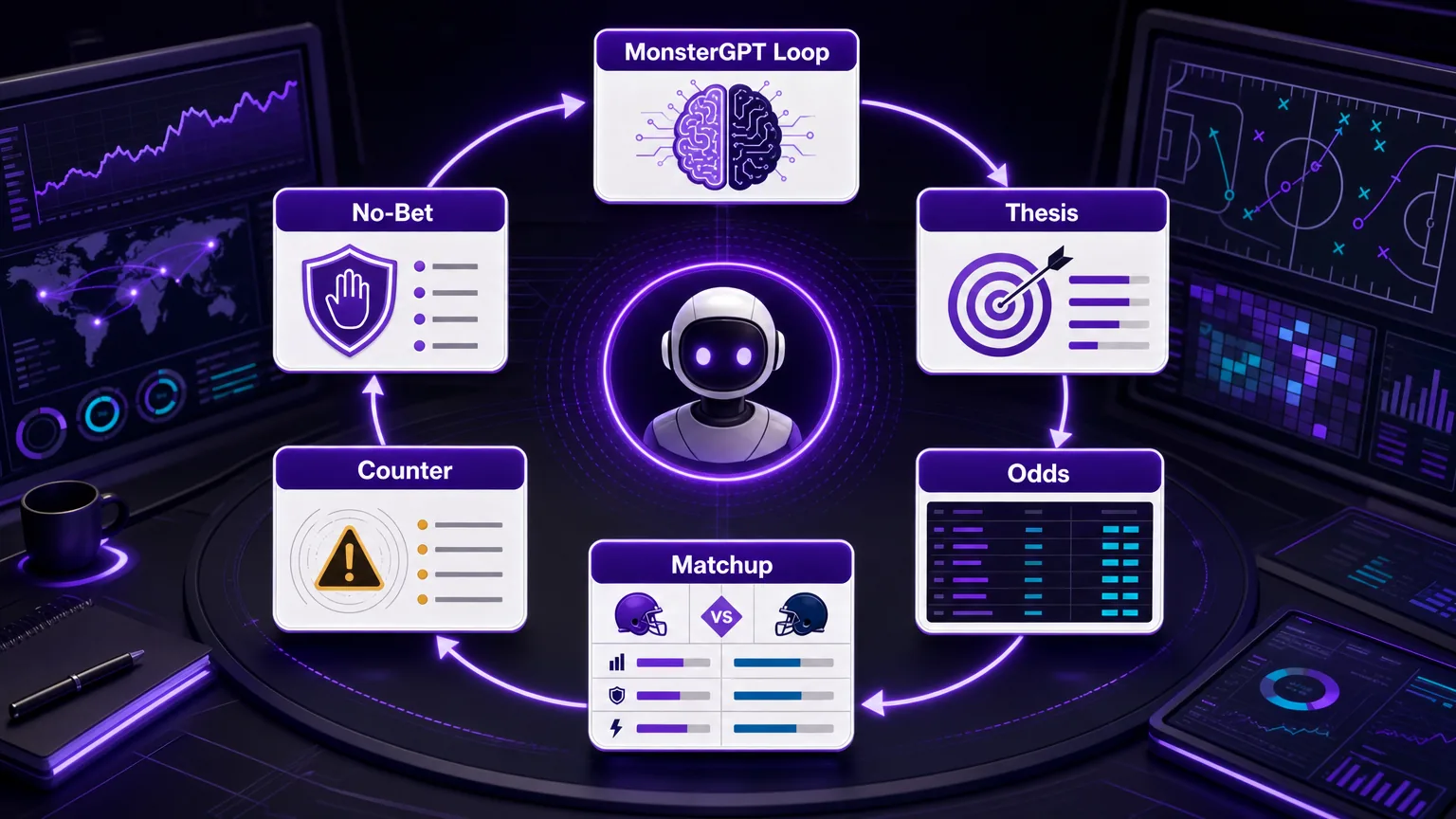
This is a good place to use MonsterGPT as a checklist helper. The AI assistant should not be asked to guarantee the bet. It can be asked to restate the required inputs and identify what must be verified.
5. Logging And Review
Most users under-log arbitrage attempts. They remember the wins and forget the failed execution. That makes the tool feel better or worse than it really is.
A strong log tracks scanner alerts, usable opportunities, books involved, margins, whether both sides were live, whether both sides were accepted, limits, stake sizing errors, and notes. After a week, the user can judge the tool by real fit.
Scanner Alerts Versus Executable Opportunities
This is the most important distinction in arbitrage tool evaluation.
A scanner alert is any opportunity the tool displays. An executable opportunity is one that matches your accounts, is still live, has enough margin, has matching rules, allows the needed stake, and can be completed on both sides.
A tool can produce a large number of alerts and still be poor for a specific user if most alerts are not executable. A tool can produce fewer alerts and still be valuable if the alerts match the user’s books and markets.
Use this table during testing:
| Metric | Weak evaluation | Strong evaluation |
|---|---|---|
| Alert count | "It showed 80 arbs." | "It showed 12 arbs I could actually place." |
| Margin | "The percentage looked good." | "The margin survived refresh and stake rounding." |
| Book access | "It monitors 20+ books." | "The useful alerts appeared at books I have." |
| Execution | "I saw the arb." | "Both sides were accepted at intended stakes." |
| Outcome | "I won one bet." | "The process worked repeatedly without hidden exposure." |
This is why Arbitrage Pro V2 should be tested with a log. Without a log, the user is judging from memory.
Where Arbitrage Pro V2 Fits
Arbitrage Pro V2 is the focused Monster Bet product for this category. The extracted page data listed an Arbitrage Scanner, Middles Finder, multi-book monitoring across 20+ sportsbooks, MonsterGPT, and Full Lab Access. It was listed at $34/week during research.
That feature set makes sense for a user who wants arbitrage and middles without buying the complete Monster Pro stack. The value proposition is narrower: find and evaluate price gaps. The subscription is easier to judge because the job is clear.
A strong Arbitrage Pro V2 buyer should ask:
- Do I have enough sportsbook accounts to use multi-book alerts?
- Do I understand stake sizing?
- Do I know how quickly opportunities disappear?
- Do I have a log for alerts and execution quality?
- Am I using MonsterGPT for checklist support rather than outcome prediction?
If yes, open Arbitrage Pro V2 on Whop and run a seven-day fit test.
Where Monster Pro Fits
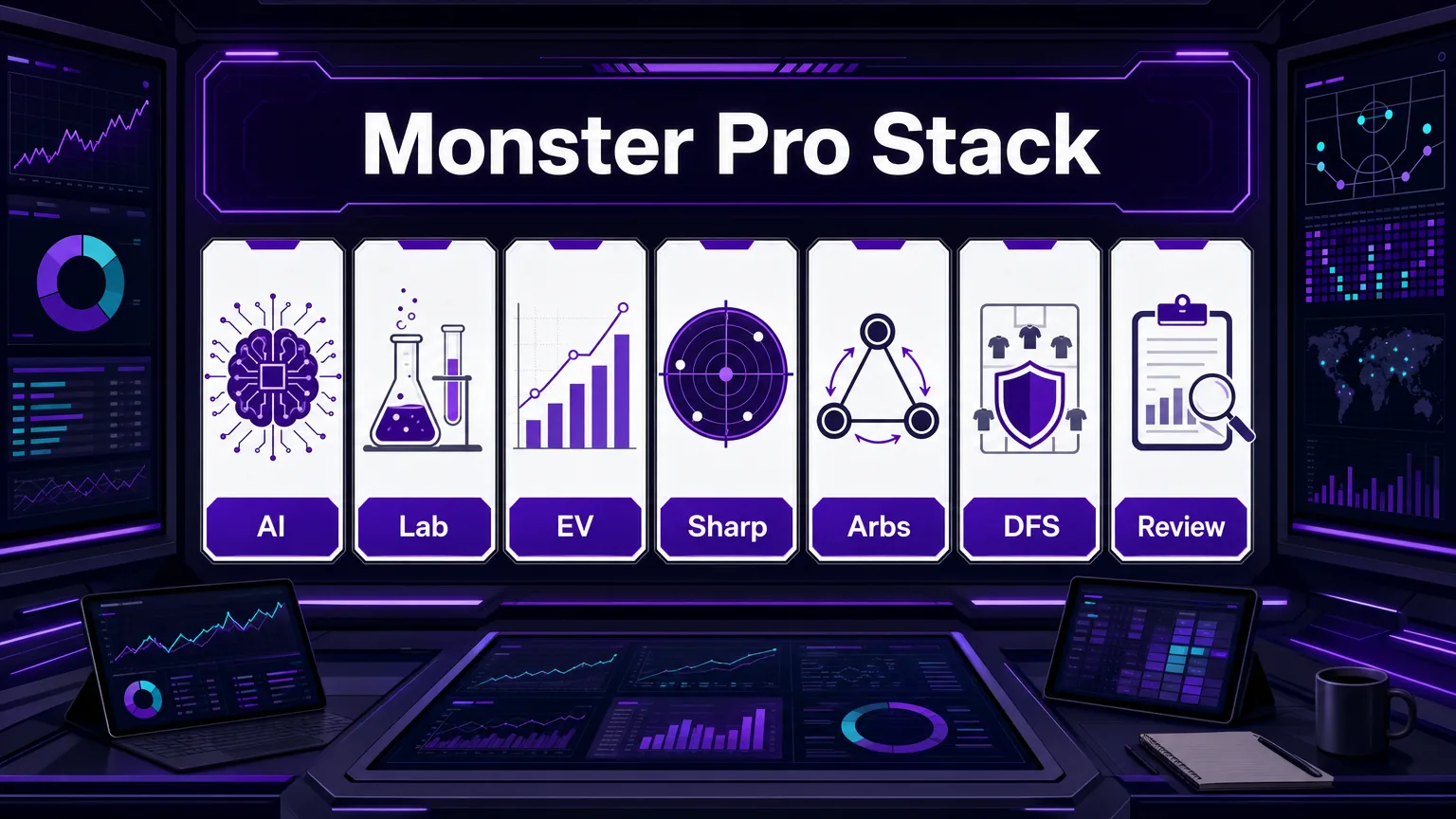
Monster Pro also includes arbitrage and middles, but it is not only an arbitrage product. Its extracted listing included the wider stack: Full Lab Access, MonsterGPT, Positive EV Finder, Sharp Money Scanner, Arbitrage and Middles, and DFS Optimizer. It was listed at $90/week during research.
Monster Pro makes more sense when arbitrage is one branch of a larger research process. If the user also wants +EV signals, sharp-money context, DFS lineup tools, and a broader data lab workflow, Monster Pro may justify the higher price.
The key is not power. The key is usage. If the user only opens the arbitrage tools, they may be paying for unused features. If the user uses the whole stack, Monster Pro becomes easier to defend.
For the comparison, read Monster Pro vs Arbitrage Pro V2, then decide whether to open Monster Pro or the focused Arbitrage Pro V2.
How To Build An Arbitrage Checklist
A checklist is the bridge between scanner discovery and real execution.
Use this before placing anything:
- Confirm both sportsbooks are available and funded.
- Confirm the market names match.
- Confirm rules, overtime treatment, and void conditions.
- Confirm both lines and odds are still live.
- Confirm the scanner’s stake sizing.
- Confirm book limits will allow the intended stake.
- Submit carefully and verify both accepted tickets.
- Save screenshots or notes if your tracking process requires it.
- Log the opportunity and any friction.
- Move on without chasing if the opportunity disappears.
The final point matters. Arbitrage users can become emotionally attached to a disappearing edge. That leads to rushed bets and bad positions. Passing is part of the process.
Common Failure Points
Stale Lines
A stale line is a price that appears available in the scanner but is no longer available in the sportsbook. Stale lines are common in fast markets. A good tool minimizes them, but no user should assume they disappear completely.
Wrong Market
Market mismatch can break the entire position. Always verify the exact market, participant, line, period, and grading rule.
Partial Execution
One side accepted and one side rejected is the classic arbitrage problem. If that happens, the bettor needs a risk plan. Better still, the user should avoid opportunities where partial execution is likely.
Thin Margins
Small margins look nice in theory but can vanish through line movement, rounding, limits, or mistakes. Beginners should be especially cautious with thin edges.
Account Limits
Sportsbooks may limit accounts or markets. Limits change whether the theoretical stake sizing is possible.
Subscription Pressure
A weekly tool fee can create pressure to act. That is dangerous. A bettor should never force an arbitrage because they want to justify a subscription.
Who Should Use Arbitrage Tools
Arbitrage tools are best for users who already have the operational setup:
- Multiple sportsbook accounts.
- Clear bankroll rules.
- Fast but careful execution habits.
- Comfort with odds and stake sizing.
- Willingness to log every attempt.
- Understanding that alerts are candidates.
- Emotional discipline to pass on stale or confusing opportunities.
If that describes you, Arbitrage Pro V2 is the most relevant Monster Bet product to evaluate.
Who Should Avoid Them
Avoid arbitrage tools if you only use one sportsbook. Avoid them if you are new to bet sizing. Avoid them if you think arbitrage is passive income. Avoid them if you feel pressured to place more bets because you are paying for software.
Also avoid them if you refuse to read rules. Sportsbooks can grade markets differently. A bettor who ignores rules can turn a clean-looking position into a bad one.
For users who want to learn research before execution, MonsterGPT may be a better first step. For users who want every tool, Monster Pro is the broader plan.
Internal Links
- Product review: Arbitrage Pro V2 Review
- Comparison: Monster Pro vs Arbitrage Pro V2
- Full stack: Monster Pro Review
- Middles guide: Middles Betting Guide
- Line shopping: Sportsbook Line Shopping
- Pricing: Monster Bet Pricing
Final Verdict
Arbitrage betting tools can be useful when they reduce search time and help users identify real book-to-book price gaps. They are not magic profit machines. The right standard is not how many alerts a scanner shows. The right standard is how many opportunities you can actually execute at your books under matching rules and correct stake sizes.
For the focused Monster Bet arbitrage workflow, open Arbitrage Pro V2 on Whop.
For arbitrage as part of a broader betting stack, open Monster Pro on Whop.
For AI-assisted research before advanced execution, open MonsterGPT on Whop.