The Short Verdict
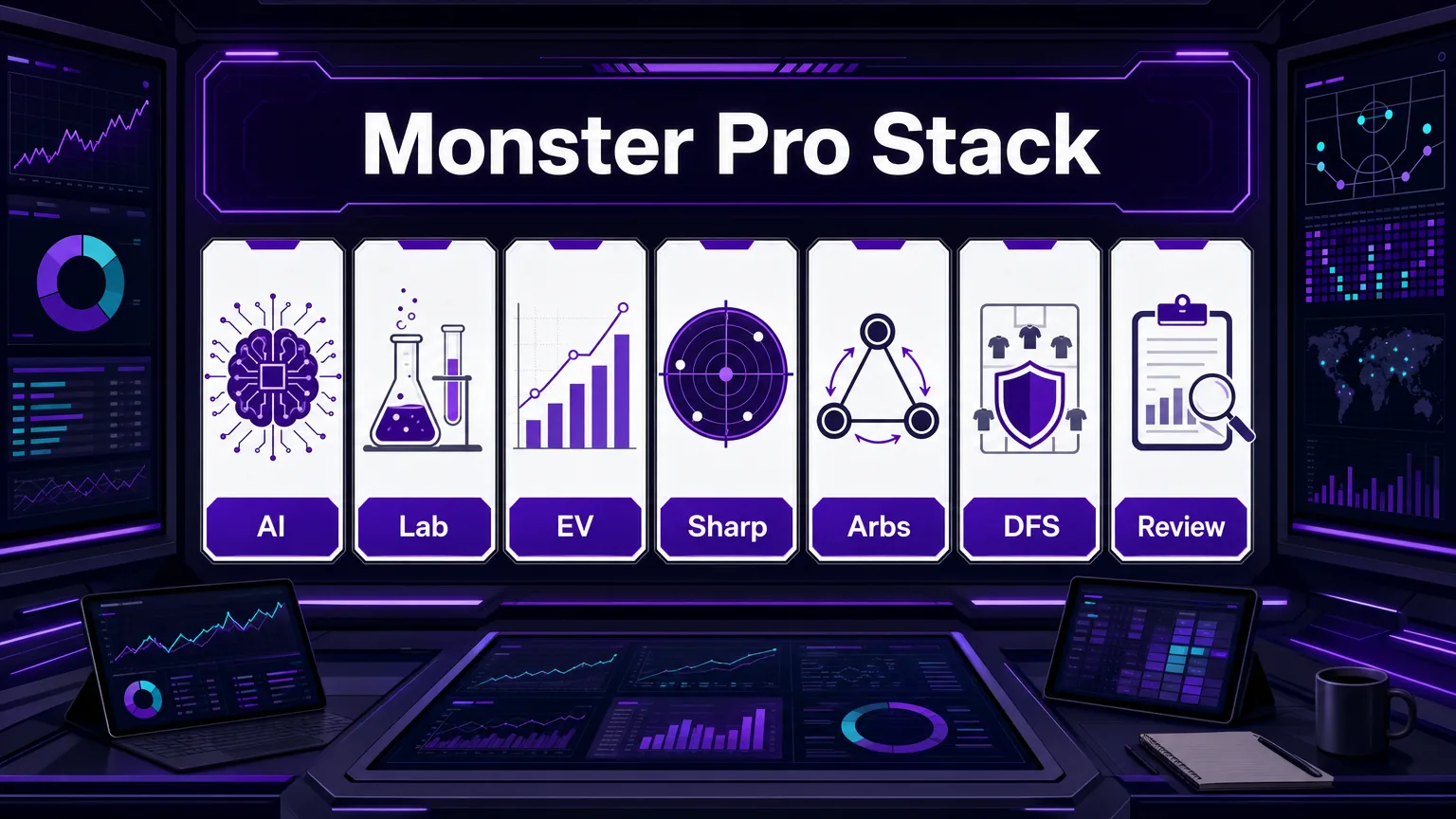
Monster Pro is the highest-intent product in the Monster Bet lineup because it is not positioned as one narrow feature. It is the complete stack: MonsterGPT, Full Lab Access, a Positive EV Finder, a Sharp Money Scanner, Arbitrage and Middles tools, and a DFS Optimizer. The listed Whop price found during research was $90 per week, with the Monster Bet brand showing a 4.4 rating from 45 reviews at the time of extraction.
That price changes the review. A cheap betting tool can be treated like a curiosity. Monster Pro cannot. At $90 per week, the correct question is not, "Does this look powerful?" The correct question is, "Will I use enough of the stack every week to make the subscription rational?"
For some bettors, the answer can be yes. If you already compare books, track injury news, build bet slips from projections, examine line movement, hunt positive expected value, watch arbitrage windows, and play DFS, then Monster Pro may consolidate work that is currently spread across tabs, spreadsheets, Discord notes, and half-finished research routines. In that case, the product is not just selling data. It is selling workflow density.
For casual bettors, the answer is usually no. If you only want a few picks before a weekend slate, Monster Pro is probably too much product. In that case, read the MonsterGPT review first and compare the lower weekly cost against your actual betting routine.
Best fit: active multi-sport bettors who will use several tools inside the same weekly workflow.
Bad fit: casual pick buyers, one-book bettors, and anyone expecting software to remove betting risk.
What Monster Pro Is
Monster Pro is the broad-access subscription inside the Monster Bet product family. The product page describes it as "The Complete Betting Edge" and lists access to every major Monster Bet tool. Based on the extracted Whop product data, Monster Pro includes:
| Included area | What it appears to support | Buyer question |
|---|---|---|
| Full Lab Access | Player projections, hit rates, odds comparison, game logs, matchup context, defense vs position rankings | Do I make research decisions from data instead of isolated picks? |
| MonsterGPT | AI assistant layered over the betting research process | Will I use an assistant to summarize, compare, and pressure-test angles? |
| Positive EV Finder | Surfaces odds that may be mispriced against a model or market expectation | Do I understand staking and variance well enough to use EV signals carefully? |
| Sharp Money Scanner | Helps inspect professional or market pressure signals | Can I separate signal from noise instead of blindly tailing movement? |
| Arbitrage and Middles | Finds line discrepancies and overlapping outcomes | Do I have enough sportsbook access and speed to execute? |
| DFS Optimizer | Supports DraftKings and FanDuel lineup construction | Do I play DFS enough to value optimizer access? |
The important part is that Monster Pro is not only an AI product. MonsterGPT is included, but Monster Pro should be judged as an operating system for research. If you only review it through the lens of AI chat, you will undercount the reason the higher price exists. If you only review it through the lens of arbitrage, you may buy too broad a subscription when Arbitrage Pro V2 is the more focused offer.
That is the main decision frame for this review: Monster Pro is only compelling when the combined stack matters.
The One Lie Monster Pro Buyers Need To Avoid
The lie: "If a betting tool has more features, it must create more edge."
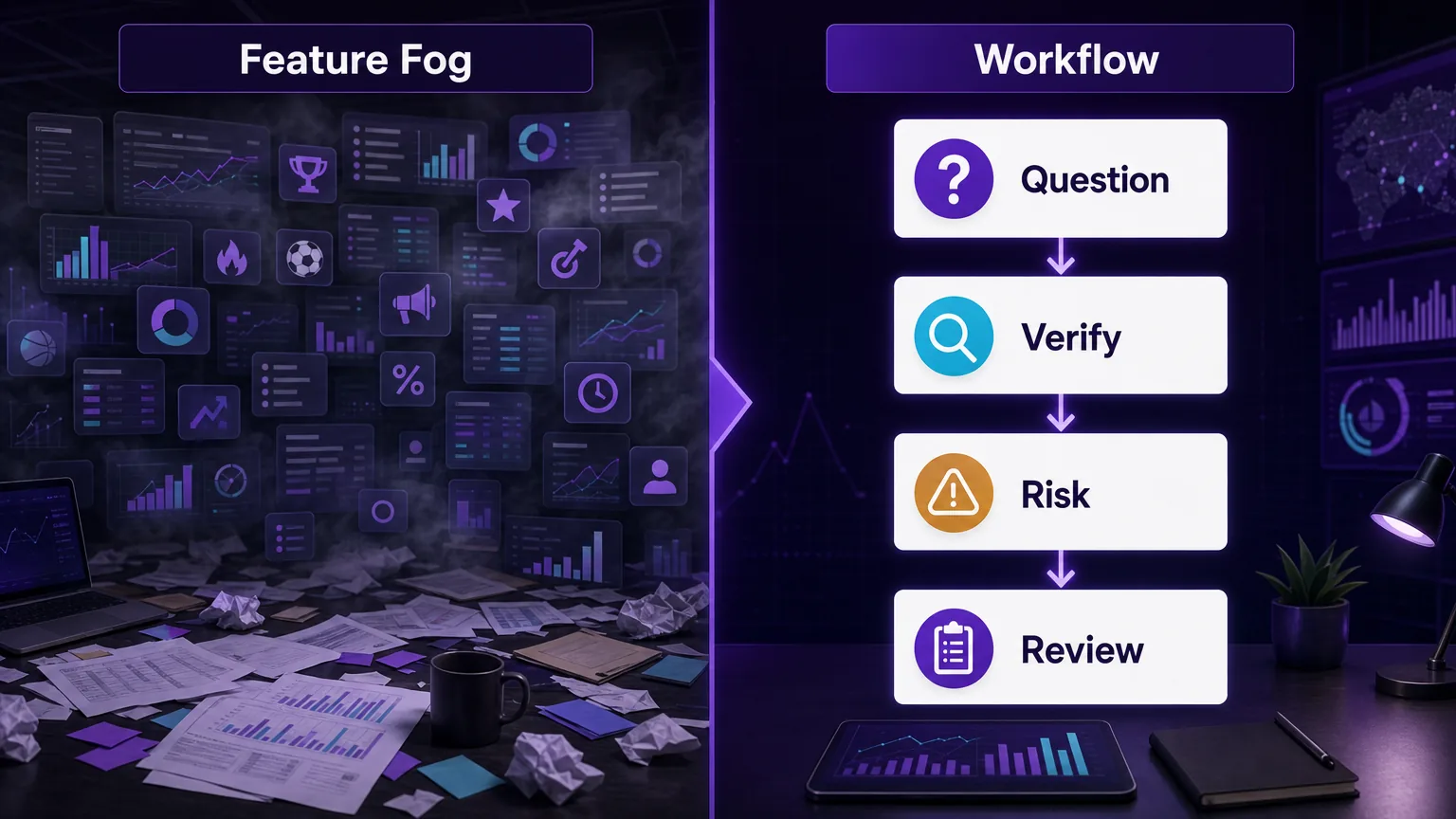
More features create more possible edges, but they also create more ways to get distracted. A bettor who opens ten dashboards without a decision process can end up with less clarity than a bettor using one clean table and a strict checklist.
The fix: judge Monster Pro by workflow completion, not feature count.
A completed workflow means you can move from slate scan to shortlist, from shortlist to price comparison, from price comparison to risk decision, and from risk decision to logged result. If Monster Pro helps you move through those stages faster and more consistently, the subscription has a real role. If it only gives you more interesting things to look at, it becomes expensive entertainment.
The number: $90 per week.
That weekly price is the discipline mechanism. A bettor does not need to moralize the purchase. They need to ask whether the tool will be used enough to justify a $90 weekly line item. If you cannot name the exact features you will use on Monday, Tuesday, Wednesday, and the weekend, start with a narrower subscription.
What Is Included In Monster Pro
Full Lab Access
The lab is the research layer. It is where Monster Bet appears to group player projections, hit rates, odds comparison, game logs, matchup context, defense versus position rankings, and multi-sport data. This matters because many betting mistakes happen before the bettor even reaches the sportsbook. They start with shallow context.
A bettor may see a player prop, remember a recent performance, and assume the line is soft. That is not research. A better process checks recent usage, matchup, projection, injury context, historical logs, and price across books. Full Lab Access is relevant because it gives the bettor a place to inspect those inputs.
The lab should not be treated as an answer machine. It should be treated as a filter. If the projection, hit rate, matchup, and available price do not line up, the bet probably belongs in the discard pile. If they do line up, the angle can move to the next step.
MonsterGPT
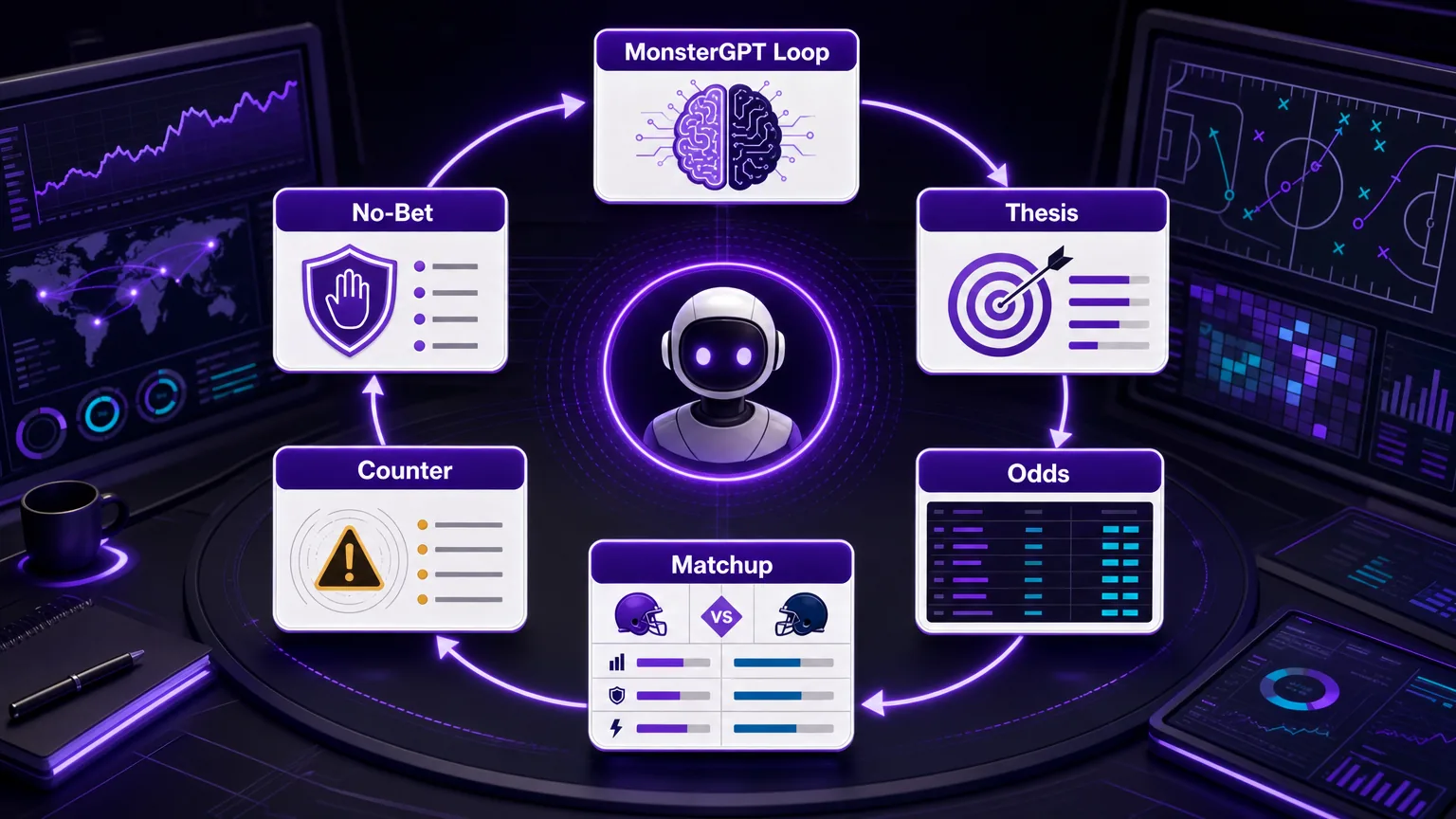
MonsterGPT is the AI assistant inside the broader stack. The best use case is not asking it for a magical pick. The better use case is asking it to compress research, compare candidate plays, explain why a signal may be weak, or produce a checklist before execution.
For example, instead of asking, "What should I bet tonight?" a disciplined user might ask:
Review these three player props using projection, matchup, game log, and odds comparison. Identify the strongest case, the weakest assumption, and the condition that would make each bet a pass.
That turns MonsterGPT into a structured research assistant, not a gambling oracle. For a deeper prompt system, see the planned MonsterGPT prompts guide.
Positive EV Finder
Positive expected value sounds simple: find a line where the offered price appears better than the estimated true probability. In practice, +EV betting is hard because edges can be thin, models can be wrong, books can move quickly, and variance can make good decisions look bad for long stretches.
Monster Pro includes a Positive EV Finder, but the right buyer will not treat every surfaced opportunity as a command. They will check liquidity, book availability, limits, injury context, line movement, and correlation with other positions. The tool can help identify candidates. The bettor still owns the risk decision.
This topic deserves its own article because +EV language is often oversold. The knowledge-web article is Positive EV Betting: Why +EV Signals Need a Risk Filter.
Sharp Money Scanner
Sharp money tools are attractive because they imply that someone more informed may be moving the market. That can be useful, but it can also be abused. A line move may reflect real information, stale pricing, limits, market-making, public pressure, or simple timing.
Monster Pro includes a Sharp Money Scanner, which means the bettor should learn how to read market pressure without becoming a blind follower. A useful sharp-money workflow asks three questions: What moved? When did it move? Does the rest of the research agree?
If the line movement supports an existing case, it can strengthen confidence. If it is the only reason for the bet, the user is probably guessing with a more sophisticated dashboard.
Arbitrage And Middles
Arbitrage and middles are execution-heavy. The product page lists Arbitrage and Middles as part of Monster Pro. That can be valuable for users who already have multiple funded sportsbook accounts and understand how quickly opportunities can disappear.
An arbitrage opportunity can look clean on a scanner and still fail in the real world because one side moves, a limit changes, a book rejects a wager, or the bettor makes a stake-size error. Middles add another layer: the bettor may try to capture an overlapping outcome zone, but the position still requires careful sizing and understanding of downside.
If this is your main reason for buying, compare Monster Pro with Arbitrage Pro V2, because the dedicated arbitrage product may fit better than the full stack.
DFS Optimizer
The DFS Optimizer is the clearest example of why Monster Pro is for active users. A sports bettor who never plays DFS should not count this as value. A DraftKings or FanDuel player, however, may find it useful if they already build lineups and want an optimizer inside the same sports data environment.
DFS value depends on projections, roster construction, contest selection, ownership assumptions, salary constraints, and late news. An optimizer can improve the mechanical process, but it cannot decide contest strategy for you. The user still needs rules.
How The Full-Stack Workflow Should Work
Monster Pro is best understood as a sequence.
Step 1: Slate Scan
Start broad. Use the lab to inspect games, players, markets, and props across the sports you actually bet. Do not start by trying to force action. A good slate scan should produce a small candidate list and a larger reject list.
Useful filter questions:
| Question | Why it matters |
|---|---|
| Is there enough data for this market? | Thin markets can be noisy. |
| Does the projection differ meaningfully from the line? | Small differences may not survive pricing friction. |
| Are multiple books showing the same number? | A stale outlier may move before execution. |
| Is there injury or lineup uncertainty? | Late news can invalidate research. |
Step 2: Candidate Shortlist
Move only the strongest angles into a shortlist. At this stage, MonsterGPT can help summarize why each candidate exists and what could break it. The goal is to avoid emotional attachment.
A useful prompt:
For each candidate, list the evidence for the bet, the evidence against it, the price sensitivity, and the reason I should pass if the line moves.
That prompt forces the assistant to create friction before action.
Step 3: Market Check
Now compare odds and line movement. This is where Positive EV, Sharp Money, Arbitrage, and Middles can help. The goal is to see whether the candidate is supported by price, contradicted by price, or no longer playable.
A common mistake is doing this backward. If a bettor starts with a scanner hit and then searches for supporting evidence, confirmation bias becomes likely. The better order is research first, price second, execution third.
Step 4: Risk Decision
Before placing anything, define stake size, book, line, price, and pass condition. If the bet requires a number that is no longer available, do not pretend the original research still applies. Sports betting is price-sensitive.
Step 5: Post-Bet Log
A tool stack becomes more valuable when it feeds a feedback loop. Track why the bet was made, what price was taken, what moved after entry, whether the process was followed, and whether the result taught anything. Do not only track wins and losses. Track decision quality.
Monster Pro Vs MonsterGPT
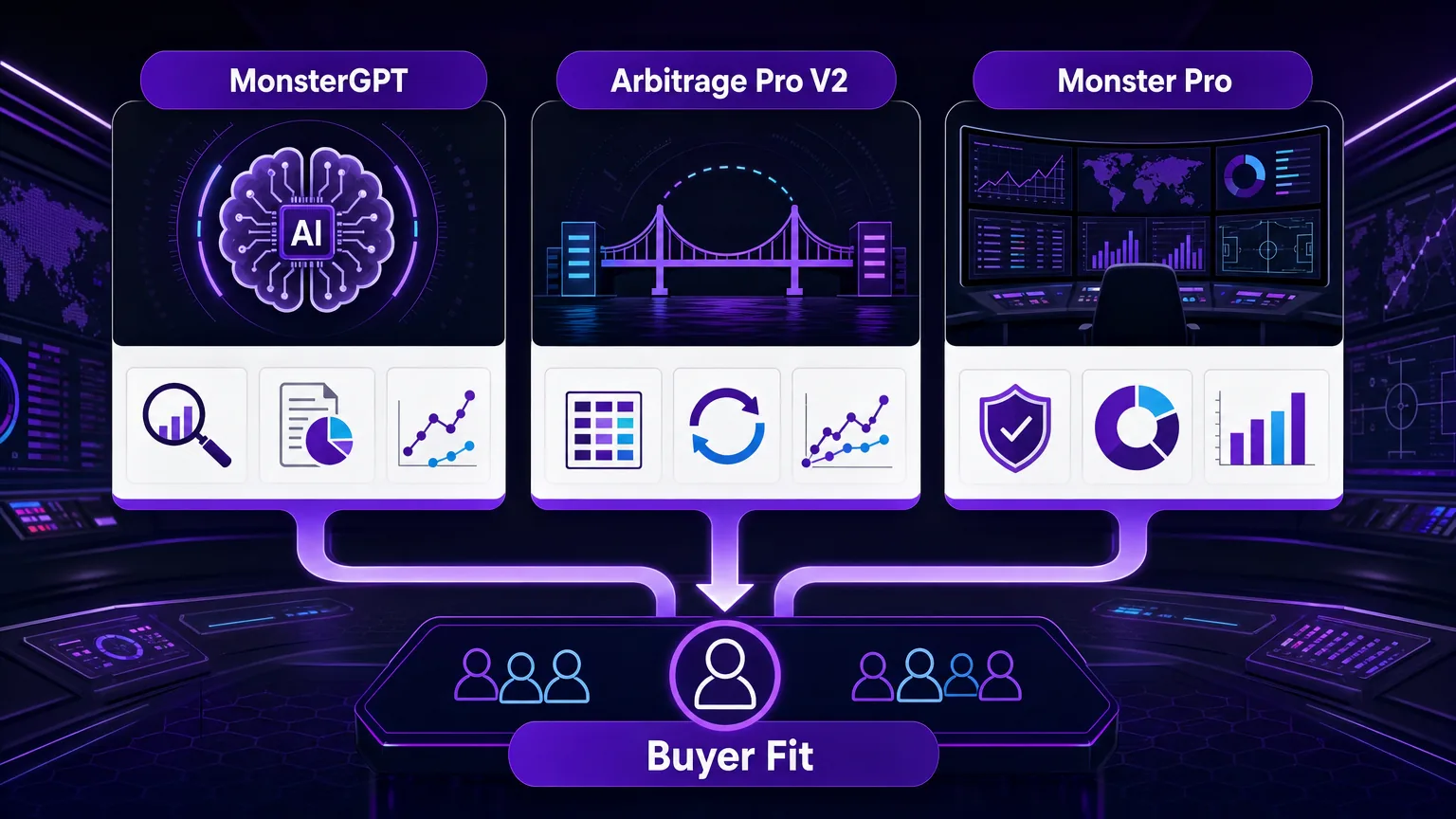
MonsterGPT is the narrower and cheaper entry point. It is centered on the AI assistant plus Full Lab Access. Monster Pro includes MonsterGPT and adds the higher-intensity tools.
| Buyer type | Better fit | Reason |
|---|---|---|
| Wants AI help reading data | MonsterGPT | Lower weekly cost and simpler scope |
| Wants research lab plus market scanners | Monster Pro | Broader stack included |
| Bets casually on one sport | MonsterGPT | Monster Pro is likely too much |
| Hunts +EV, arbitrage, middles, DFS | Monster Pro | More tools match the workflow |
| Still learning basic line shopping | MonsterGPT first | Build discipline before adding complexity |
If you are deciding between the two, start with the question: "Will I use the Positive EV Finder, Sharp Money Scanner, Arbitrage and Middles, and DFS Optimizer this week?" If the honest answer is no, start with MonsterGPT. If the honest answer is yes, Monster Pro deserves the deeper look.
Monster Pro Vs Arbitrage Pro V2
Arbitrage Pro V2 is more focused. It is built around arbitrage, middles, multi-book monitoring, MonsterGPT, and Full Lab Access. Its extracted listed price was $34 per week, compared with Monster Pro at $90 per week.
That gap matters. If arbitrage and middles are the main reason you are shopping, the dedicated product may be the better first test. If you also care about +EV signals, sharp-money analysis, DFS optimization, and the complete Monster Bet toolkit, Monster Pro is the broader choice.
| Question | If yes | If no |
|---|---|---|
| Do you already have several sportsbook accounts? | Arbitrage tools may matter | Arbitrage value may be limited |
| Do you play DFS weekly? | Monster Pro gains value | Do not count DFS Optimizer as value |
| Do you understand execution risk? | You can test arbitrage responsibly | Learn before relying on scanner outputs |
| Do you want one complete betting dashboard? | Monster Pro fits better | Narrow product may be enough |
Read the focused review here: Arbitrage Pro V2 Review.
Who Monster Pro Is Best For
Monster Pro fits the user who already has a routine but wants that routine compressed.
The best-fit buyer probably:
- Bets or researches multiple sports.
- Uses more than one sportsbook.
- Understands that odds movement changes expected value.
- Wants to inspect projections, hit rates, matchup data, and game logs.
- Uses AI as a research assistant, not as a guaranteed pick source.
- Has enough weekly betting or DFS volume to justify a $90 subscription.
- Is willing to track results and decision quality.
This matters because the product is not priced for passive use. Monster Pro can look impressive in screenshots, but screenshots do not create value. Repeated usage creates value.
A practical buyer should be able to say:
I will use Full Lab Access for slate scanning, MonsterGPT for summarizing and pressure-testing, Positive EV Finder for candidate discovery, Sharp Money Scanner for market confirmation, Arbitrage and Middles for execution windows, and the DFS Optimizer for lineup construction.
If that sentence feels natural, Monster Pro is aligned with your workflow.
Who Should Skip It
Skip Monster Pro if you want a pick seller. The product is not best judged as a simple answer feed, and using it that way wastes the point of the stack.
Skip it if you only use one sportsbook. Arbitrage, middles, and line shopping need access to multiple books. Without that, a large part of the product’s value may be theoretical.
Skip it if $90 per week creates pressure to bet more. This is important. A subscription should not make a bettor chase volume just to justify the fee. If the cost changes your staking behavior, the product is too expensive for your current situation.
Skip it if you do not want to learn the tools. Monster Pro has enough moving parts that the first week should be treated as onboarding, not as instant profit week.
Skip it if you cannot accept losing stretches. Even good processes can lose. Positive EV is not a promise. Sharp money is not a promise. Arbitrage can fail through execution. DFS optimizers can build bad lineups if inputs or strategy are weak.
Seven-Day Evaluation Plan
Use the first week as a test. Do not judge Monster Pro by whether one bet wins. Judge whether it improves your process.
| Day | Evaluation task | Pass condition |
|---|---|---|
| Day 1 | Map every included tool and decide which ones you will actually use | You can name the tools that matter to your workflow |
| Day 2 | Run a slate scan using Full Lab Access | You create a candidate list and a reject list |
| Day 3 | Use MonsterGPT to pressure-test candidates | The assistant reveals at least one weak assumption |
| Day 4 | Compare candidates against odds and market movement | You pass on plays where price no longer works |
| Day 5 | Test Positive EV and sharp-money signals without blindly tailing | You record why a signal is actionable or not |
| Day 6 | If relevant, test arbitrage, middles, or DFS optimizer workflow | You understand execution steps and failure points |
| Day 7 | Review whether the $90 weekly cost fits actual usage | You can justify renewal without forcing action |
If the week ends with clear process gains, Monster Pro may be worth continuing. If the week ends with unused tools, confused dashboards, and forced betting, downgrade or cancel.
Internal Links For The Knowledge Web
Use this article as the hub for the full-stack decision. It should link outward to narrower articles and comparison pages:
- For the simpler AI-assisted path: MonsterGPT Review
- For the focused arbitrage path: Arbitrage Pro V2 Review
- For the price decision: Monster Bet Pricing
- For scanner discipline: Positive EV Betting and Sharp Money Scanner
- For execution-heavy markets: Arbitrage Betting Tools and Middles Betting Guide
- For odds discipline: Sportsbook Line Shopping
- For proof reading: Monster Bet Reviews and Proof
Every article in the cluster should point back here when the user asks whether the full stack is worth it.
Final Verdict
Monster Pro makes the most sense when the buyer already knows why the full stack matters. It is the wrong product to buy because it sounds powerful. It is the right product to test when you can name the exact workflows it will support: data lab research, AI-assisted review, +EV filtering, sharp-money context, arbitrage and middles execution, and DFS lineup construction.
The strongest reason to choose Monster Pro is consolidation. Instead of bouncing between disconnected tools, the user gets the complete Monster Bet stack in one Whop product. The weakest reason to choose it is the hope that more features will create automatic profit. That is not how betting works.
If you want the full Monster Bet toolkit and can justify the $90 weekly cost through real usage, start here: Open Monster Pro on Whop.
If you mainly want the AI assistant and data lab, start with MonsterGPT. If you mainly want arbitrage and middles, compare Arbitrage Pro V2 before paying for the broader plan.