
The Short Version
Positive EV betting means looking for prices that appear better than the true probability of an outcome. If a bettor believes a market should be priced one way and a sportsbook offers a better price, the bet may have positive expected value. That does not mean the bet will win. It means the price may be favorable if the estimate is accurate and the process is repeated with discipline.
Monster Pro is the relevant Monster Bet product here because the extracted Whop listing included a Positive EV Finder as part of the full stack. MonsterGPT and Full Lab Access can support the research layer, but the Positive EV Finder belongs to Monster Pro. If +EV signals are a core part of your workflow, open Monster Pro on Whop.
This guide exists because +EV is one of the easiest betting concepts to oversell. The phrase sounds mathematical and precise. The real workflow is messier. The estimate can be wrong, the price can move, the market can be thin, the user can stake poorly, and variance can make good decisions look bad for long periods.
What Positive EV Betting Means
Expected value is a long-run concept. It compares the potential payout of a bet with the estimated probability of that bet winning. A positive expected value bet is one where the offered odds appear generous relative to the estimated chance.
The simplest version looks like this:
| Input | Meaning |
|---|---|
| Estimated probability | What the bettor or model thinks the real chance is |
| Sportsbook odds | The price being offered |
| Implied probability | What the odds suggest about chance before hold and market context |
| Edge | The difference between estimated probability and offered price |
| Stake | The amount risked under bankroll rules |
The hard part is not the formula. The hard part is believing the estimate only when it deserves trust. A bettor can call anything +EV if the probability estimate is careless. That is why +EV tools need risk filters.
The One Lie About EV Signals
The lie: "+EV means safe."
Positive EV does not mean safe. It means a price may be favorable under a probability estimate. The bet can still lose. Many +EV bets will lose. A user can also misread a signal, act after the line has moved, use the wrong stake size, or follow a model in a market where the model is weak.
The fix: separate signal, confidence, and stake.
A signal tells you an opportunity may exist. Confidence tells you how much supporting evidence you have. Stake tells you how much risk you are willing to take. Those are different decisions.
The number: one risk filter for every +EV signal.
Before acting on any +EV alert, apply at least one hard filter: minimum edge, market liquidity, book availability, line freshness, injury uncertainty, stake cap, or model confidence. If the signal cannot survive a filter, pass.
Where Monster Pro Fits
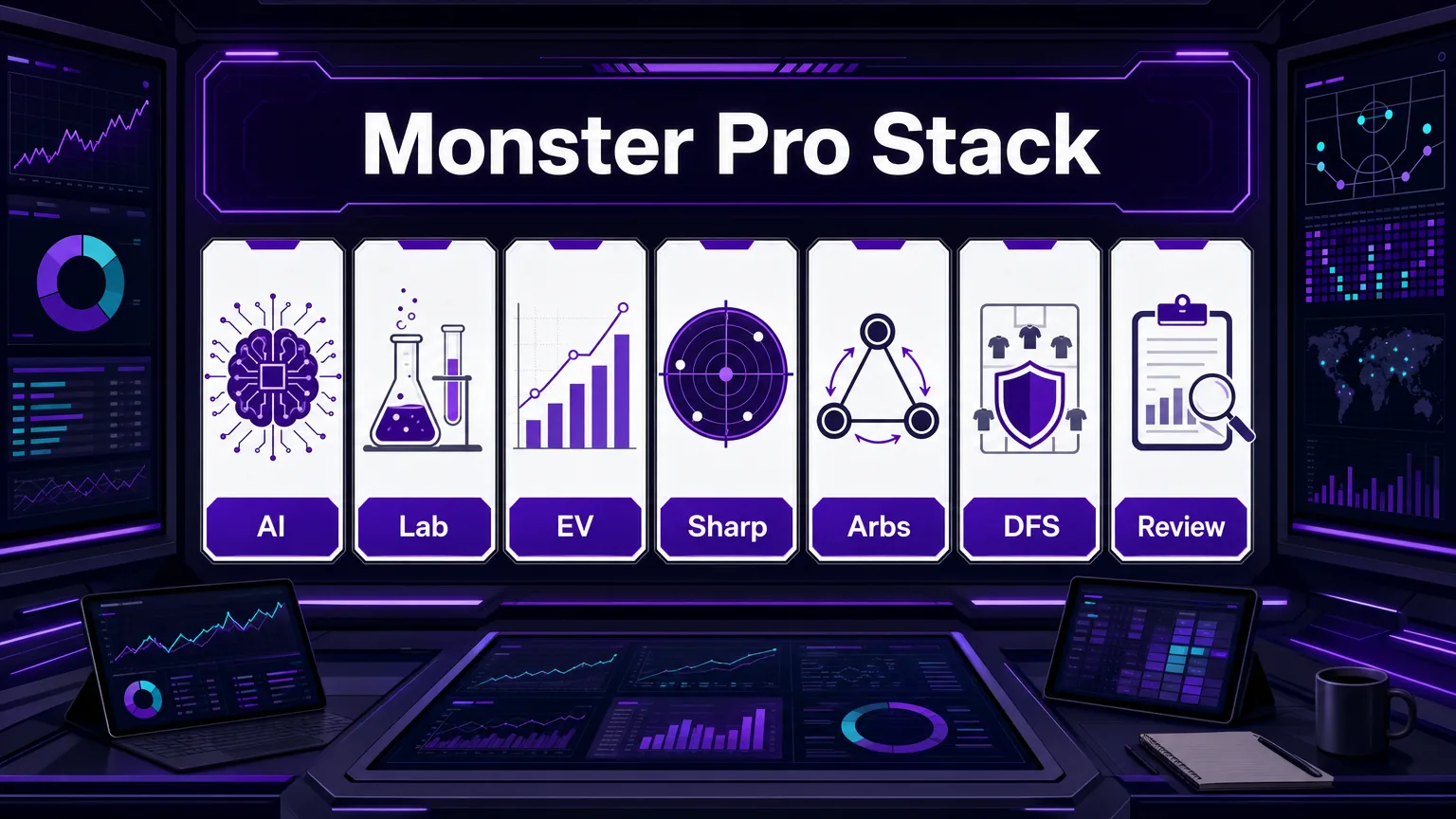
Monster Pro includes the Positive EV Finder alongside MonsterGPT, Full Lab Access, Sharp Money Scanner, Arbitrage and Middles, and DFS Optimizer. That matters because +EV signals should not live alone. They need context.
A Positive EV Finder can help discover candidates. Full Lab Access can help inspect projections, logs, hit rates, and matchup context. MonsterGPT can summarize the case and identify weak assumptions. Sharp-money tools can add market movement context. Odds comparison can show whether the price is still playable.
The full-stack workflow is the selling point. A bettor who only wants AI-assisted research may not need Monster Pro. A bettor who actively hunts value across markets may find the Positive EV Finder one of the main reasons to choose it.
CTA: Open Monster Pro on Whop.
The Risk Filter Every EV Signal Needs
Filter 1: Price Freshness
A +EV signal can die quickly. If the price has moved since the signal appeared, the edge may no longer exist. Always confirm the current book price before acting.
Filter 2: Minimum Edge
Not every tiny edge is worth action. Thin edges can disappear through movement, rounding, limits, and user error. A minimum edge filter helps users avoid chasing noise.
Filter 3: Market Quality
Some markets are sharper and more liquid than others. Some are thin, slow, or heavily affected by news. A signal in a soft prop market may be interesting, but it may also be more fragile.
Filter 4: News Sensitivity
Injuries, starting lineups, weather, rest, minutes limits, and late scratches can change the true probability. If the signal depends on uncertain news, size and confidence should reflect that.
Filter 5: Book Access And Limits
A signal is useless if you cannot bet the book or if the book will not accept the required stake. Track which books produce usable signals for you.
Filter 6: Correlation And Exposure
A bettor may unknowingly stack correlated positions. Several +EV bets tied to the same game script can create concentrated exposure. A risk filter should inspect portfolio-level risk, not only single-bet edge.
Filter 7: Personal Process Quality
If you are tired, rushing, tilted, or trying to recover losses, skip the signal. A good price does not fix a bad mental state.
How To Use MonsterGPT With EV Research
MonsterGPT can make +EV research more disciplined if prompted correctly.
Good prompts:
- "Explain why this +EV signal may be valid and list the top three reasons it may be misleading."
- "Compare this signal against projection, matchup, game log, and current odds."
- "Create a pass checklist for this bet if the line moves or injury news changes."
- "Summarize my exposure if I already have related bets in this game."
- "Turn these five +EV candidates into a ranked shortlist based on confidence and risk."
Bad prompts:
- "Will this +EV bet win?"
- "How much should I bet to guarantee profit?"
- "Give me all the best locks."
The assistant is most useful when it slows the user down. It should create a written case, not emotional certainty.
If you only need AI support and lab access, MonsterGPT may be enough. If you need the Positive EV Finder, Monster Pro is the relevant product.
A Practical EV Workflow
Use this sequence:
- Start with the Positive EV Finder to identify a candidate.
- Confirm the current price at the sportsbook.
- Check whether the edge survives your minimum threshold.
- Inspect projections, hit rates, logs, and matchup context.
- Ask MonsterGPT for the strongest counterargument.
- Check market movement and news sensitivity.
- Confirm stake size under bankroll rules.
- Log the bet, price, reason, and pass condition.
- Review process quality after the result.
The workflow matters because +EV betting is repetitive. One bet does not prove much. The process has to hold across many decisions.
Common Mistakes
Treating Every Signal Equally
A +EV tool may show many candidates. They do not all deserve the same confidence. Rank them.
Ignoring Line Movement
A signal at one price may be gone at another. If the line moved, re-evaluate.
Betting Too Large
Expected value does not eliminate variance. Stake size should respect bankroll rules.
Trusting A Black Box
If you cannot explain why the signal exists, be careful. You do not need to know every model detail, but you do need enough context to avoid blind action.
Chasing After Losses
A +EV label does not justify tilt. If the previous result changes your behavior, stop.
Who Should Use EV Tools
+EV tools fit users who already understand variance, price sensitivity, and tracking. They are useful for bettors who can pass on weak signals and log decisions honestly.
They are not ideal for users who want certainty. They are also not ideal for beginners who have not learned odds, implied probability, and line shopping.
For active users, Monster Pro is the Monster Bet product to evaluate because it includes the Positive EV Finder and the surrounding stack.
Internal Links
- Full-stack review: Monster Pro Review
- Data lab workflow: Sports Betting Data Lab
- Sharp-money guide: Sharp Money Scanner Guide
- Line shopping guide: Sportsbook Line Shopping
- Pricing decision: Monster Bet Pricing
Final Verdict
Positive EV betting is useful only when the user respects the difference between favorable price and guaranteed outcome. Monster Pro is the relevant Monster Bet product because it includes the Positive EV Finder plus the lab, MonsterGPT, sharp-money context, arbitrage and middles, and DFS tools.
For active value-focused bettors, open Monster Pro on Whop.
For AI-assisted research before using advanced value tools, open MonsterGPT on Whop.
Seven-Day Workflow Test
A paid betting tool should be judged before renewal, not after a lucky or unlucky result. For Positive EV Betting: Why +EV Signals Need a Risk Filter, the practical test is seven days long because the public Monster Bet offers are weekly products. The question is not whether Monster Pro sounds useful. The question is whether it changes a decision that would otherwise be weaker, slower, or more emotional.
Start the test with a written baseline. Before opening the tool, write down how you normally handle this workflow: where the idea comes from, which data you check, how often you compare prices, what makes you pass, and how you decide stake size. This matters because a tool can feel valuable simply because it creates more activity. Activity is not the same as improvement. A cleaner process should make the bettor more selective, not just busier.
During the week, log every meaningful interaction in the positive EV signal review lane. Record the initial idea, the tool or screen used, the price or line checked, the strongest reason to pass, the final action, and the later review note. A pass counts as a useful outcome when the tool helps reject a weak position. That is one of the easiest values to miss. Better research is not only about finding more bets; it is also about removing bad ones before they reach the slip.
At the end of the week, score the tool on behavior, not outcome. Did it force better questions? Did it expose a stale price? Did it reveal a mismatch between the headline and the actual line? Did it reduce impulsive bets? Did it create a repeatable checklist? If the answer is no, the product may still be interesting, but it has not earned automatic renewal.
Renewal Checklist
Use this checklist before renewing, upgrading, or switching plans:
| Renewal question | Keep testing | Pause or downgrade |
|---|---|---|
| Did the tool change a real decision this week? | Yes, with examples in the log. | No, it mostly created browsing time. |
| Did it help you pass on weaker bets? | Yes, the pass reasons are visible. | No, it mostly increased action. |
| Did you compare price and risk before betting? | Yes, every logged idea has a price note. | No, the tool became a confidence shortcut. |
| Did the plan match the workflow? | Yes, Monster Pro was used for positive EV signal review. | No, the plan's main features stayed unused. |
| Is the risk still explicit? | Yes, losses, limits, stale lines, and uncertainty are written down. | No, the tool made betting feel cleaner than it is. |
This checklist is deliberately strict. Sports betting tools should support research and workflow, but they do not guarantee wins, profit, or personal outcomes. The most useful Monster Bet plan is the one that earns a place in a disciplined routine. The least useful plan is the one that creates enough excitement to hide the absence of a routine.
Common Mistakes To Avoid
The first mistake is treating positive EV signal review as a complete betting process. It is one lane. It still has to connect to bankroll rules, sportsbook availability, timing, line movement, and a final pass condition. If those pieces are missing, the tool can increase confidence faster than it increases discipline.
The second mistake is judging the tool from one result. A winning bet can hide bad process, and a losing bet can follow good process. The better review is a sample of decisions: bets placed, bets passed, numbers compared, prompts asked, signals ignored, and renewal notes. That review is less exciting than a single result, but it is much harder to fool.
The third mistake is ignoring the specific risk in this lane: a positive EV label can be treated like permission to skip price, limit, timing, and bankroll checks. Write that risk at the top of the log. If the week proves that the risk is manageable, keep testing. If the week proves that the risk keeps showing up, do not solve it by buying a bigger plan. Solve the workflow first.
Practical Next Step
If this article describes the exact workflow you need to improve, inspect the relevant Monster Bet offer on Whop: open Monster Pro on Whop. Use the link as the start of a test, not as a promise. Decide what the tool must prove before the next renewal date, then measure that proof in your own log.
Decision Log Template
Use this simple log while testing the ideas from Positive EV Betting: Why +EV Signals Need a Risk Filter. The point is to capture the decision before the outcome changes the story.
| Field | What to write |
|---|---|
| Idea source | Where the bet, prop, lineup, signal, or line-shopping question came from. |
| Tool used | Which Monster Bet feature, article checklist, sportsbook screen, or research note changed the review. |
| Price checked | The exact number, book, and time checked before action. |
| Reason to pass | The strongest reason not to bet, even if you eventually placed it. |
| Final action | Bet, pass, wait, reduce stake, compare another book, or review later. |
| Review note | What the decision teaches after the result, without pretending the result proves everything. |
This template keeps the workflow grounded. It also protects the reader from the most common failure in positive EV signal review: replacing process with feeling. A tool can surface information, but it cannot force a bettor to respect the information. The written log creates that friction.
The cleanest version is short. One row per decision is enough. If the log becomes too complicated, the user will stop using it. If it is too vague, it will not reveal whether Monster Pro changed anything meaningful. Keep the fields practical, review them before renewal, and judge the plan by repeated behavior rather than one exciting result.