The Short Version
A sports betting data lab is not a place where bets become certain. It is a system for slowing down bad decisions and making good questions easier to ask. The point is to move from guesswork to structured research: projections, hit rates, odds comparison, game logs, matchup context, defense-versus-position information, and price sensitivity.
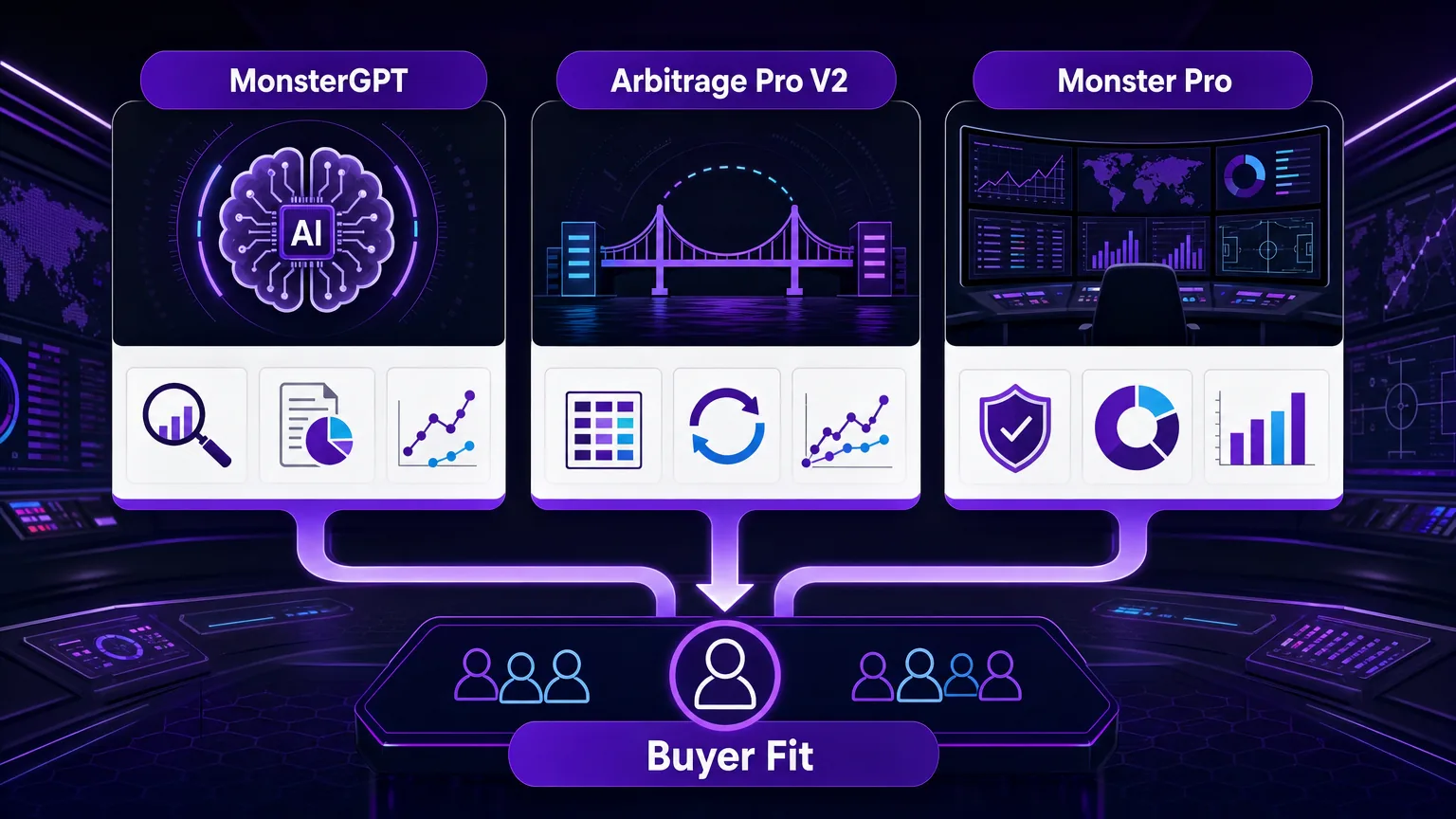
That is why Monster Bet’s Full Lab Access matters in the product lineup. The extracted Whop research showed Full Lab Access connected to MonsterGPT, Monster Pro, and Arbitrage Pro V2. MonsterGPT was positioned as an AI betting assistant plus Full Data Lab Access at $27/week. Monster Pro included the lab plus the full stack at $90/week. Arbitrage Pro V2 included the lab as support for arbitrage and middle workflows at $34/week.
This article is not a product review. It is the workflow article that explains how to use a data lab without drowning in data. If you want the AI-plus-lab product, start with MonsterGPT on Whop. If you want the lab as part of a full scanner stack, compare Monster Pro.
What A Sports Betting Data Lab Is
A sports betting data lab is a repeatable research environment. It helps you answer the same core questions before every bet:
| Question | Data needed | Why it matters |
|---|---|---|
| What does the projection say? | Player or team projection | Establishes a baseline expectation |
| What has happened recently? | Game logs and usage trends | Shows role, minutes, volume, and volatility |
| Is the matchup favorable? | Defense vs position, opponent profile | Adds context beyond raw averages |
| What price is available? | Odds comparison | Determines whether the angle is still playable |
| What would make this a pass? | Injury news, line movement, role change | Prevents forced bets |
The lab does not replace judgment. It gives judgment better inputs. A bettor who already knows what to ask can move faster. A bettor who does not know what to ask can use the lab to build better habits.
The mistake is treating data like decoration. Many bettors open dashboards, scan numbers, find one stat that supports the bet they already wanted, and call it research. That is confirmation bias with better lighting. A real data lab should create friction before a bet is placed.
The One Lie About Betting Data
The lie: "More data means a better bet."
More data only helps when it is organized around a decision. If you add projections, hit rates, game logs, odds, matchup data, news, and AI commentary without a process, you may become more confident without becoming more accurate.
The fix: start every research session with a pass condition.
A pass condition is the reason you will not bet. Examples: the line moved too far, the player role is uncertain, the projection edge is too small, the matchup context disagrees, the book price is worse than alternatives, or the bet depends on one fragile assumption.
The number: one pass condition before one stake.
Before you decide stake size, write down the condition that would make the bet a pass. If you cannot name one, you are probably looking for permission rather than evidence.
The Five Data Layers That Matter
1. Projections
Projections are the starting point, not the verdict. A projection estimates an expected outcome based on inputs. It can help identify whether a line appears high, low, or fair. But projections can be wrong, especially when news, role changes, pace, matchups, or small samples matter.
A projection is most useful when compared against the market. A player projected for 24.5 points against a line of 23.5 may look interesting, but the edge may be too thin. A player projected for 27.5 against a line of 23.5 may deserve more inspection. The projection should create a shortlist, not an automatic bet.
2. Hit Rates
Hit rates show how often an outcome has cleared a threshold in a chosen sample. They are easy to understand and easy to misuse. A prop going over in seven of the last ten games can be relevant, but the sample may hide role changes, weak opponents, overtime, injuries, or unusual game scripts.
Use hit rates as context. Do not use them as proof. A high hit rate with a worse current line may be less valuable than a lower hit rate with a strong projection and better price.
3. Game Logs
Game logs are where the story becomes more specific. They show minutes, usage, attempts, rebounds, assists, shots, ice time, targets, carries, or other sport-specific volume indicators. They help answer whether a result came from stable opportunity or a one-game spike.
MonsterGPT can be useful here because game logs are dense. Ask it to summarize what changed across recent games, but verify the underlying numbers before acting.
4. Matchup Context
Defense-versus-position rankings and opponent tendencies can help explain why a projection may be high or low. But matchup data should not be isolated from role. A great matchup does not matter if the player’s usage is falling. A bad matchup does not automatically kill a bet if the player has a stable role and the price is generous.
The correct question is not, "Is the matchup good?" The better question is, "Does the matchup strengthen or weaken the projection enough to affect the price decision?"
5. Odds Comparison
Odds comparison is where research becomes a betting decision. The same angle can be playable at one book and unplayable at another. If a bettor does not compare books, they may do good research and still take a bad number.
This is why line shopping deserves its own guide: Sportsbook Line Shopping.
How MonsterGPT Fits The Lab
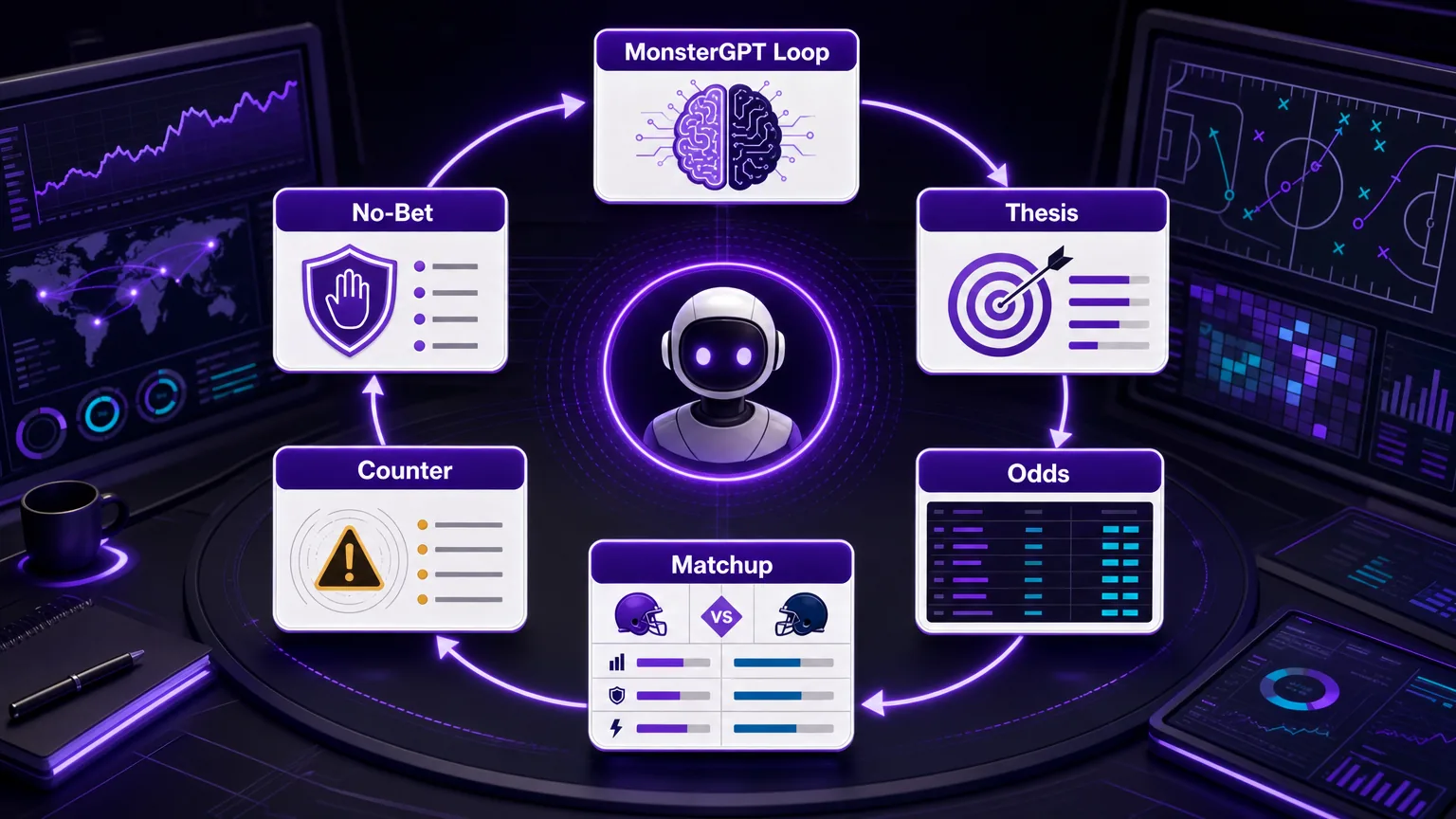
MonsterGPT is best used as a research assistant. It should summarize, compare, organize, and challenge. It should not be treated as a pick oracle.
Good MonsterGPT prompts include:
- "Summarize the case for and against this player prop using projection, hit rate, recent game logs, matchup, and current price."
- "What would make this bet a pass if the line moves?"
- "Compare these three candidates and rank them by research quality, not by excitement."
- "Identify the weakest assumption in this angle."
- "Turn this slate research into a shortlist and reject list."
Bad prompts include:
- "What is the lock?"
- "What will definitely hit?"
- "Give me a guaranteed bet."
- "Tell me how much to stake so I win."
The AI layer is valuable when it creates structure. It is dangerous when it creates false certainty.
CTA: If your main need is AI-assisted lab work, open MonsterGPT on Whop.
How Monster Pro Expands The Lab
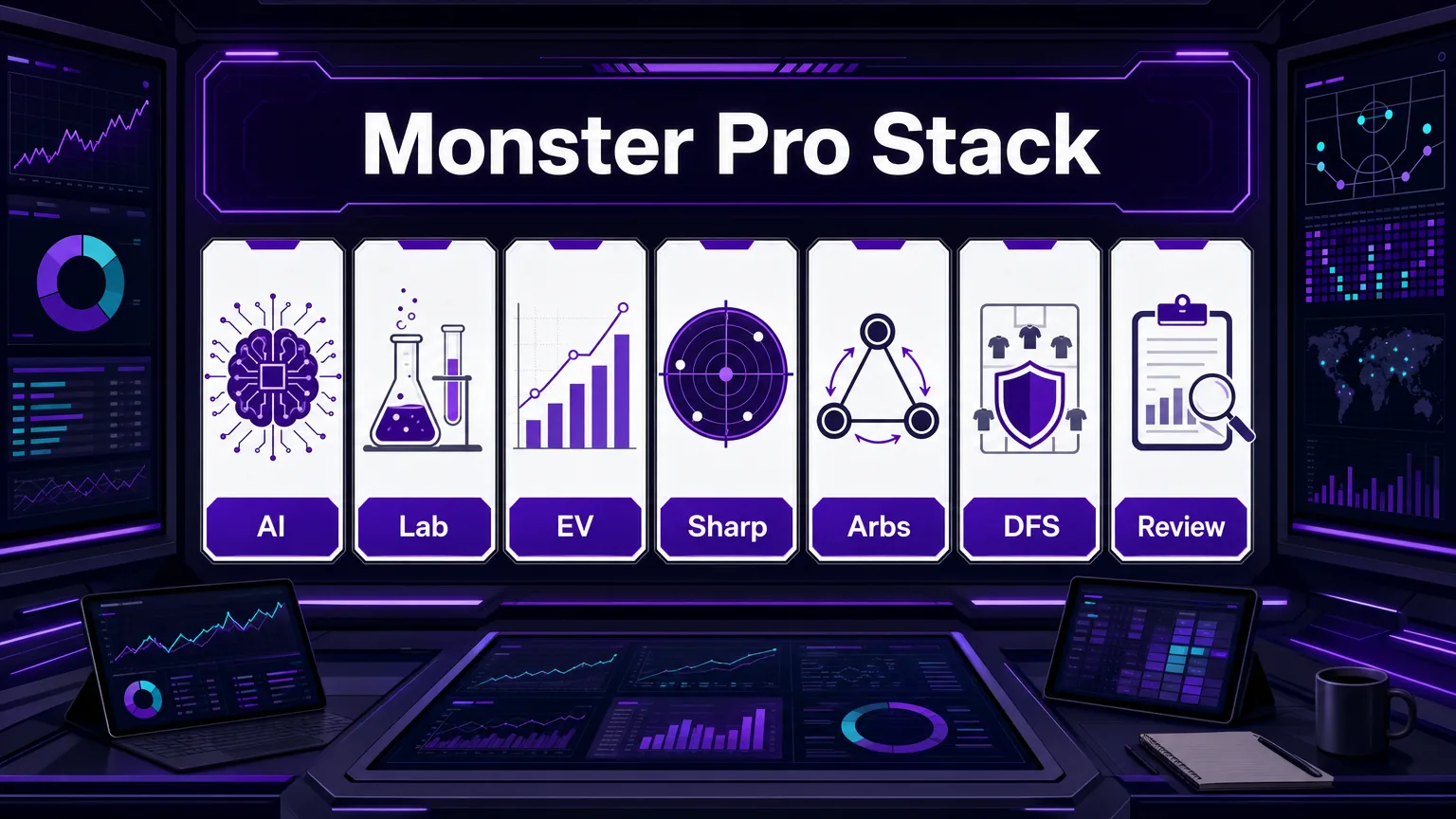
Monster Pro adds market and execution tools on top of the lab. The extracted listing included Positive EV Finder, Sharp Money Scanner, Arbitrage and Middles, and DFS Optimizer. These tools expand the lab from research into market interpretation.
That matters for active bettors. A lab can identify a candidate. The Positive EV Finder can help inspect whether the price may be favorable. Sharp-money tools can add market movement context. Arbitrage and middles can reveal book-to-book opportunities. DFS Optimizer can support lineup construction for users who play daily fantasy.
The risk is complexity. A user who has not mastered the lab can become overwhelmed by the full stack. A user who has a strong process may benefit from having more tools in one workflow.
CTA: If you need the lab plus the full scanner and optimizer stack, open Monster Pro on Whop.
A Repeatable Research Workflow
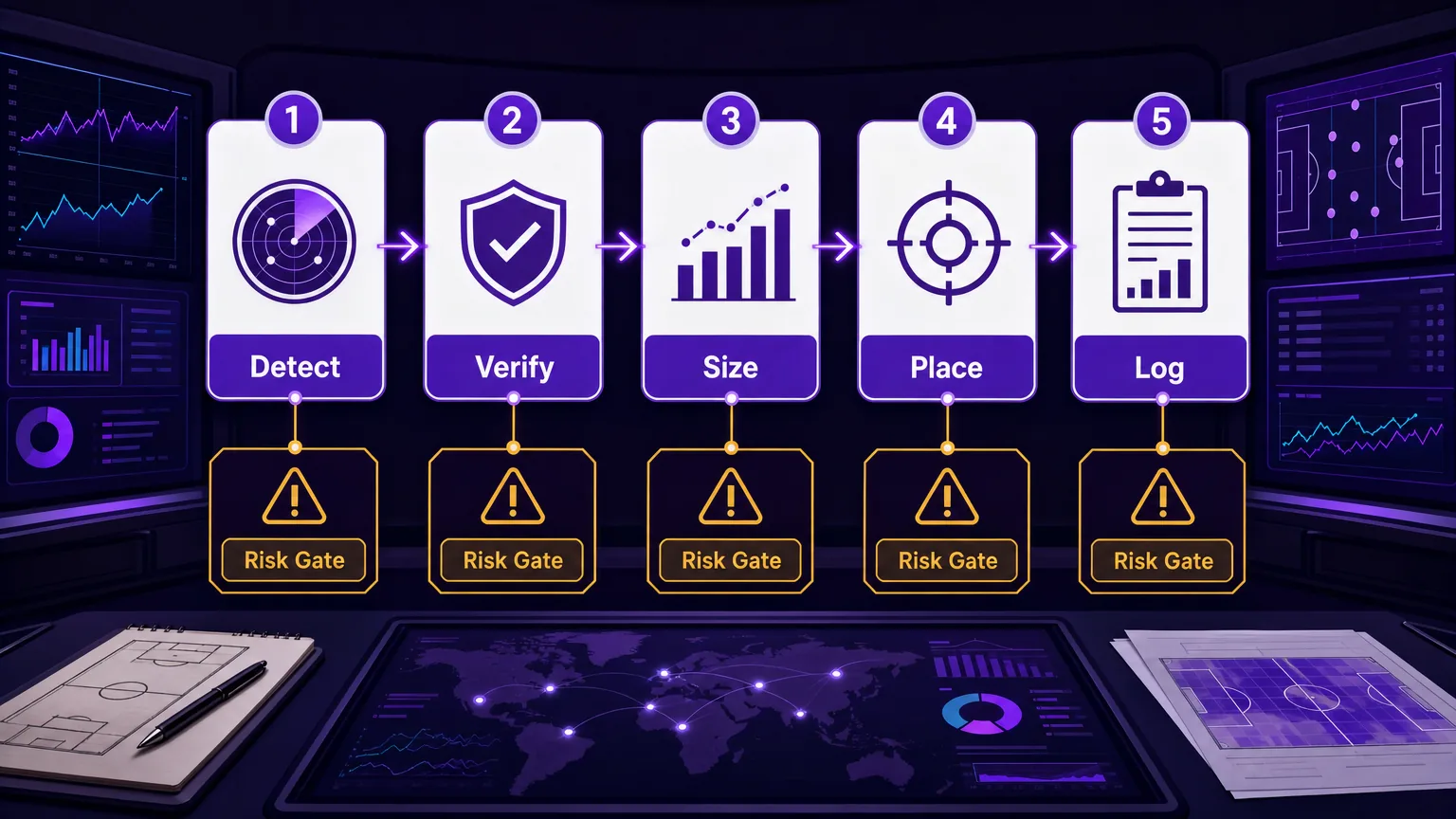
Use this sequence before every serious bet:
Step 1: Start With The Market
Pick one market type. Do not scan everything. Choose player points, rebounds, assists, strikeouts, rushing yards, moneylines, totals, or another defined area. Narrowing the market prevents random browsing.
Step 2: Pull Candidate Lines
Use available lines to build a candidate list. Do not decide yet. The goal is to collect possible angles.
Step 3: Compare Projections
Check whether projections meaningfully differ from the lines. Remove candidates where the gap is too small or unclear.
Step 4: Inspect Logs And Role
Use game logs to check whether the projection has a stable foundation. Look for minutes, attempts, usage, lineup changes, injuries, and volatility.
Step 5: Add Matchup Context
Check defense-versus-position or opponent tendencies. Ask whether the matchup materially changes the case.
Step 6: Compare Prices
Look across books. If the best price is gone, the bet may be gone too. Do not force the original thesis at a worse number.
Step 7: Ask MonsterGPT To Pressure-Test
Use the assistant to summarize the best argument against the bet. If the argument is strong, pass or reduce confidence.
Step 8: Log The Decision
Record the line, price, book, stake, reasoning, pass condition, and result. This is how the lab becomes a learning system.
What To Log After Each Bet
A useful betting log should include more than wins and losses.
| Field | Purpose |
|---|---|
| Date | Tracks timing and slate context |
| Sport and market | Reveals where your process works |
| Book and price | Shows whether you got good numbers |
| Projection | Records baseline expectation |
| Key supporting data | Keeps reasoning visible |
| Key risk | Prevents revisionist memory |
| Pass condition | Shows whether you respected the process |
| Closing line or later price | Helps evaluate price quality |
| Result | Outcome tracking |
| Process grade | Separates good decisions from lucky results |
A bettor can win with a bad process and lose with a good process. The log helps tell the difference.
Common Data Mistakes
Cherry-Picking One Stat
A user finds one stat that supports the bet and ignores everything else. The fix is requiring a counterargument before every bet.
Ignoring Price
A bettor does good research but takes a bad number. The fix is odds comparison.
Overweighting Recent Results
Recent games matter, but they can mislead. The fix is asking whether recent performance came from stable role or temporary conditions.
Treating AI As Authority
MonsterGPT can structure analysis, but the user owns verification. The fix is asking the assistant to show assumptions and reasons to pass.
No Feedback Loop
Without a log, the same mistakes repeat. The fix is tracking process quality.
Who Should Use This Workflow
This workflow fits users who want to become more disciplined. It is useful for bettors who already place bets and want more structure. It also fits beginners who want to learn research before paying for more advanced scanner tools.
MonsterGPT is the most natural entry point because it pairs AI assistance with the data lab. Monster Pro is better when the user already wants the lab plus market scanners and DFS tools.
Internal Links
- AI product review: MonsterGPT Review
- Full-stack review: Monster Pro Review
- Plan comparison: Monster Pro vs MonsterGPT
- Positive EV guide: Positive EV Betting
- Sharp-money guide: Sharp Money Scanner Guide
- Line shopping guide: Sportsbook Line Shopping
Final Verdict
A sports betting data lab is valuable when it improves questions, not when it creates false certainty. Monster Bet’s Full Lab Access is relevant because it gives users a place to inspect projections, hit rates, logs, matchup context, and prices. MonsterGPT can make that lab easier to use by summarizing and pressure-testing research.
For AI-assisted lab work, open MonsterGPT on Whop.
For the lab plus the full scanner and optimizer stack, open Monster Pro on Whop.
Seven-Day Workflow Test
A paid betting tool should be judged before renewal, not after a lucky or unlucky result. For How to Build a Sports Betting Data Lab with Monster Bet Tools, the practical test is seven days long because the public Monster Bet offers are weekly products. The question is not whether MonsterGPT or Monster Pro sounds useful. The question is whether it changes a decision that would otherwise be weaker, slower, or more emotional.
Start the test with a written baseline. Before opening the tool, write down how you normally handle this workflow: where the idea comes from, which data you check, how often you compare prices, what makes you pass, and how you decide stake size. This matters because a tool can feel valuable simply because it creates more activity. Activity is not the same as improvement. A cleaner process should make the bettor more selective, not just busier.
During the week, log every meaningful interaction in the data-lab research lane. Record the initial idea, the tool or screen used, the price or line checked, the strongest reason to pass, the final action, and the later review note. A pass counts as a useful outcome when the tool helps reject a weak position. That is one of the easiest values to miss. Better research is not only about finding more bets; it is also about removing bad ones before they reach the slip.
At the end of the week, score the tool on behavior, not outcome. Did it force better questions? Did it expose a stale price? Did it reveal a mismatch between the headline and the actual line? Did it reduce impulsive bets? Did it create a repeatable checklist? If the answer is no, the product may still be interesting, but it has not earned automatic renewal.
Renewal Checklist
Use this checklist before renewing, upgrading, or switching plans:
| Renewal question | Keep testing | Pause or downgrade |
|---|---|---|
| Did the tool change a real decision this week? | Yes, with examples in the log. | No, it mostly created browsing time. |
| Did it help you pass on weaker bets? | Yes, the pass reasons are visible. | No, it mostly increased action. |
| Did you compare price and risk before betting? | Yes, every logged idea has a price note. | No, the tool became a confidence shortcut. |
| Did the plan match the workflow? | Yes, MonsterGPT or Monster Pro was used for data-lab research. | No, the plan's main features stayed unused. |
| Is the risk still explicit? | Yes, losses, limits, stale lines, and uncertainty are written down. | No, the tool made betting feel cleaner than it is. |
This checklist is deliberately strict. Sports betting tools should support research and workflow, but they do not guarantee wins, profit, or personal outcomes. The most useful Monster Bet plan is the one that earns a place in a disciplined routine. The least useful plan is the one that creates enough excitement to hide the absence of a routine.
Common Mistakes To Avoid
The first mistake is treating data-lab research as a complete betting process. It is one lane. It still has to connect to bankroll rules, sportsbook availability, timing, line movement, and a final pass condition. If those pieces are missing, the tool can increase confidence faster than it increases discipline.
The second mistake is judging the tool from one result. A winning bet can hide bad process, and a losing bet can follow good process. The better review is a sample of decisions: bets placed, bets passed, numbers compared, prompts asked, signals ignored, and renewal notes. That review is less exciting than a single result, but it is much harder to fool.
The third mistake is ignoring the specific risk in this lane: more data can still create worse decisions when the bettor only hunts for confirming numbers. Write that risk at the top of the log. If the week proves that the risk is manageable, keep testing. If the week proves that the risk keeps showing up, do not solve it by buying a bigger plan. Solve the workflow first.
Practical Next Step
If this article describes the exact workflow you need to improve, inspect the relevant Monster Bet offer on Whop: open MonsterGPT or Monster Pro on Whop. Use the link as the start of a test, not as a promise. Decide what the tool must prove before the next renewal date, then measure that proof in your own log.